


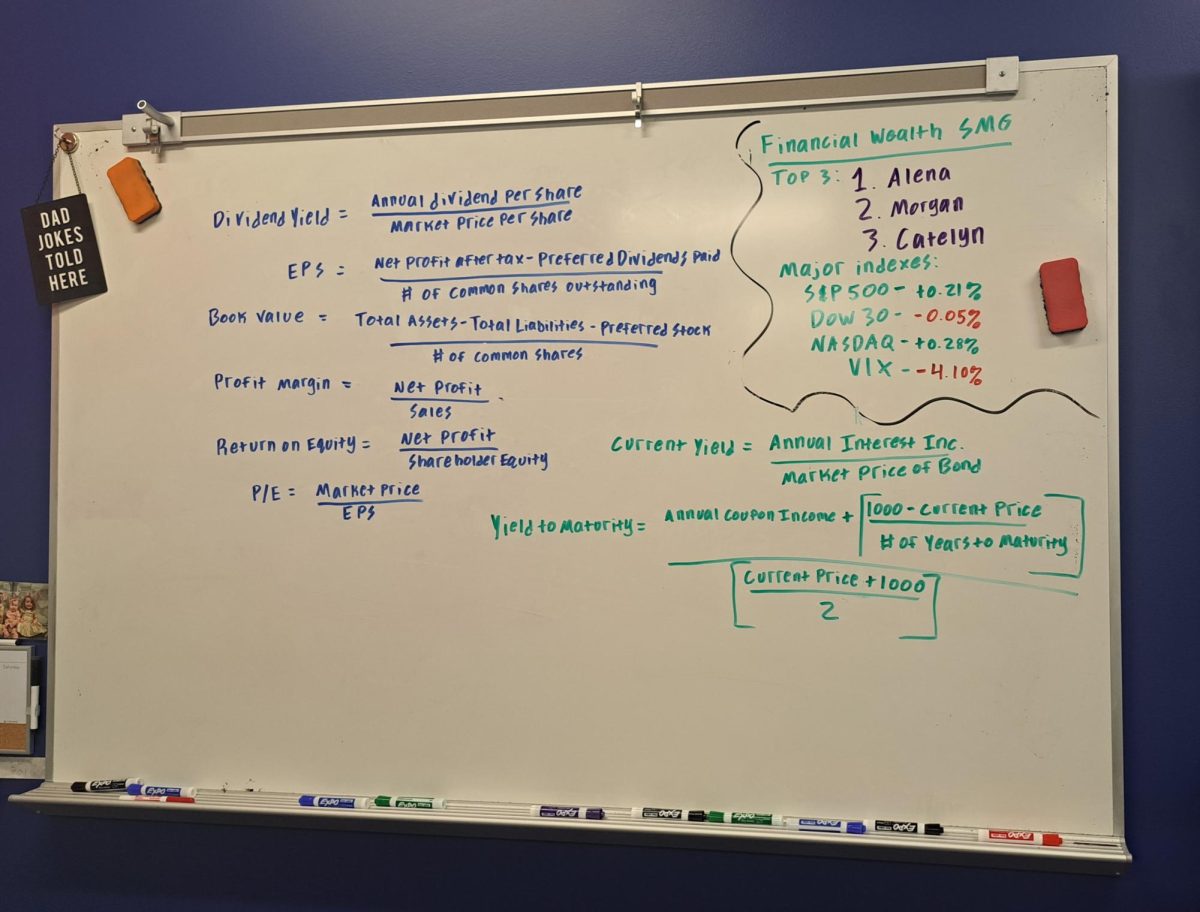
Students sit in six or seven classes, for seven or eight hours a day, five days a week, ruminating over subjects they couldn’t care less about.
Many math teachers hear, “When am I ever going to use this in real life?” English teachers hear, “I can just look it up.” What’s the point of getting an education if the value of that education isn’t immediately clear?
This hands-off disinterest in the material that students are presented with has become more and more widespread. For years, high school students have decried the importance of the frustrating and sometimes mundane subjects such as, brace yourself, math and English.
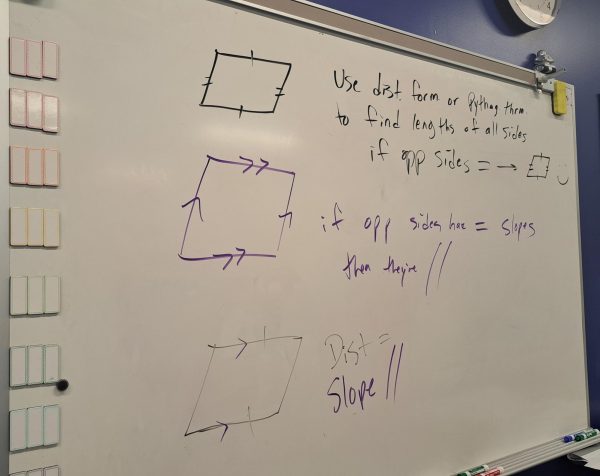
“Math is a pretty hot and cold subject where students typically like it a lot, or like it very little,” math teacher Chris Peters said.
Courtesy of Chris Peters (Photo by Marsha Akula)
Many students can relate to this love-hate relationship with math, but others express an undying love and appreciation for it.
“Math definitely matters,” senior Hailey Schinning said. “I love math.”
According to the International Commission on Mathematical Instruction, math matters because of its role in understanding every other subject. For the sciences, it is clear why math plays a huge role: physics is a heavily mathematical subject, chemistry, though it isn’t first to come to mind, also depends on accurate calculations and ratios, and biology, the least likely sub-subject of science one about, pulls from math to gain a deeper understanding of cellular, physiological, and ecological functions.
In the realm of social studies, according to The SAGE Handbook of the Philosophy of Social Sciences, economics, psychology, human geography, and anthropology all utilize statistical methods to analyze data and create hypotheses in order to explain societal qualities quantitatively.
Economics, in particular, is heavily reliant on mathematical principles, utilizing functions to describe cause and effect relationships, expressing equations graphically, and solving models with graphs.
Math provides the mental discipline and knowledge for other subjects. Math pushes students to think critically and apply themselves to solve problems; this work ethic is applicable both inside and outside the classroom.
Separately, English enables students to engage critically with complex and challenging topics, such as race, war, death, and politics.
Although English teachers and English enthusiasts tout English as a cornerstone of any high school curriculum, many students still find it difficult to view it as anything other than another class to pass.
“I feel that I haven’t learned anything because we’re taught the same thing every year,” senior Carly Siedschlag said.
As a whole, students feel that part of the education they are receiving does not prepare them for future careers, and that some subjects are not necessary for their career path.
“If it doesn’t pertain to you, then it doesn’t matter unless you need it for your job,” Schinning said. “For me, history doesn’t really matter; science matters a little, not much for what I want to do”.
Originally, Schinning wanted to be a mechanic, but after graduation, she plans to attend Capitol Beauty School for cosmetology.

But is the value of our education determined by career-preparedness?
“High school is not job training; there are programs you can go into to train you for a job,” Peters said.
High school education serves as a stepping stone to an individual’s future. There aren’t enough hours in the week, weeks in a month, or months in a school year to thoroughly prepare students for future careers.
What students are getting primed for are “higher levels of thinking” and the ability to reason through problems. The ability to solve problems is more important than the applicability of subjects to specific careers.
Ultimately, meaning is what individuals make for themselves. An individual’s attitude towards a subject affects both their perception of the subject and how well they perform. It would be to everyone’s advantage to complete this hurdle and move forward with a toolkit that will help them improve their lives.
“Education isn’t just about memorizing things; it’s about understanding and being able to problem solve,” science teacher Daryle LaFleur said. “The more education you get, the more it becomes pertinent and relevant.”






Anonymous • Dec 18, 2025 at 1:48 PM
Thanks for the six seven drop. Reallyyyyy needed that today. In all seriousness, really good story!