

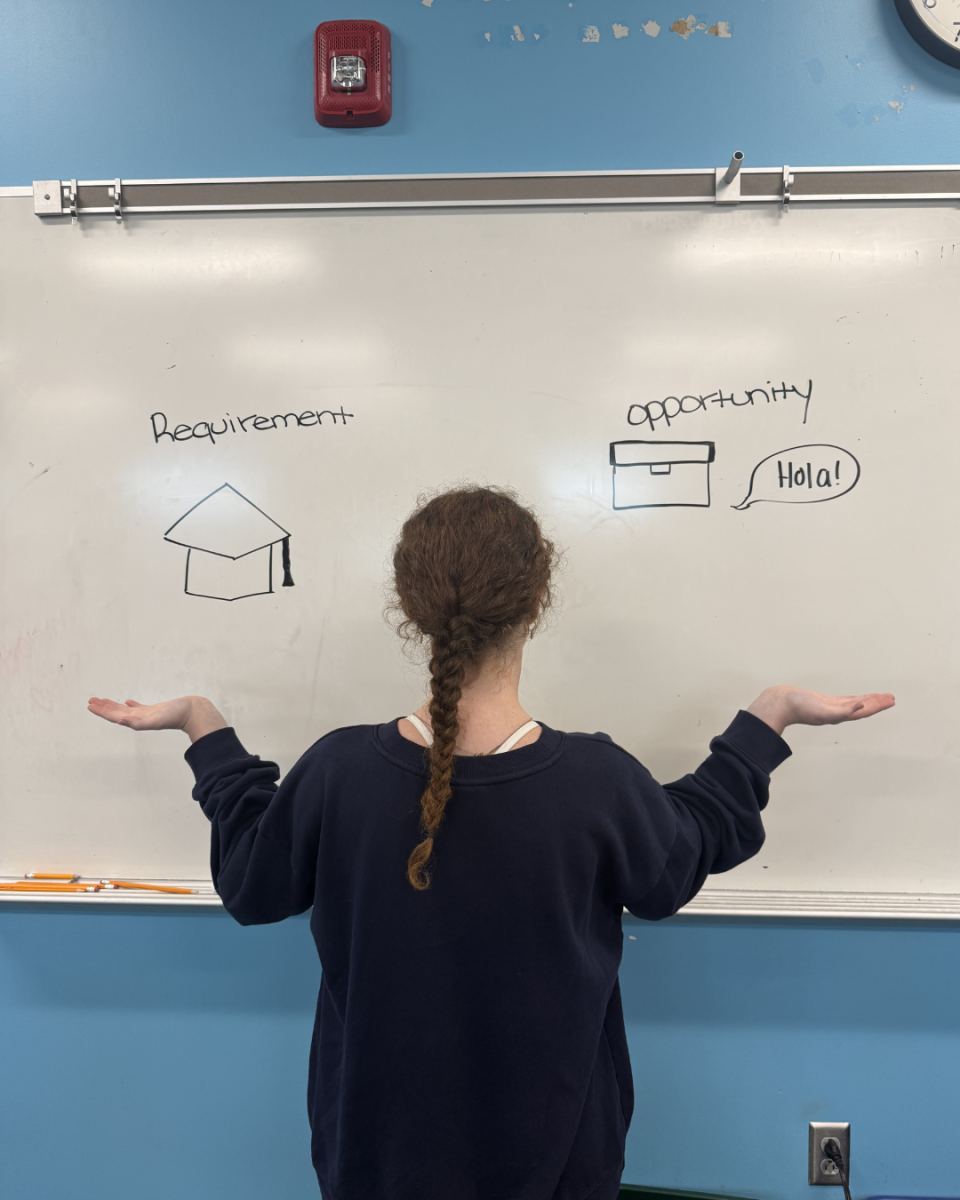
For many students, Spanish is a class that they dread going to and feel relief once they finish the schools’ requirement of two years in a foreign language. However, some students choose to take it further and move on to Spanish III, IV, or AP Spanish. The decision to continue past Spanish II has more factors than just ability, such as mindset, motivation, or a distinct purpose.
One big reason students choose to continue learning Spanish is in order to learn more about their family culture or become connected to a different culture.
“My dad spoke Spanish and I have a little bit of family in Mexico, so I thought it was important to stay connected with them,” AP Spanish student and senior Reid Cameron.
Some don’t have that personal connection to the language but they continue the class for the benefits it gives.
“Globally, it is important to learn other languages. It opens up doors to you, and you have so many more opportunities for jobs when you’re bilingual,” spanish teacher Tomi Connelly said.
In business, healthcare, education, or government jobs, being bilingual gives double the opportunities and benefits. It gives a better and deeper understanding of the world itself as well.
In jobs, people who are bilingual usually have a 5-20% higher salary and it makes peoples resumes stand out. They get picked to be hired over people who only speak either just spanish or english. Also in healthcare and education it provides an easier way to be of service to someone with a language barrier.
“Research shows that it helps rewire things in your brain. Studies show when you’re speaking in different languages you think differently because of the structure of the language,” Connelly said. So, it helps you as a human to see the world in a totally different way.”
This different way of seeing the world can lead to greater empathy for others.
“With more bilingual people the world could be better,” Cameron said. “ socially you get to know more people, and have empathy for more people who are in different situations and backgrounds.”
However, these benefits don’t show how hard it is to continue learning Spanish. Specifically, Students in AP and Spanish IV, struggle when the class is less memorization and is more about actually communicating in the language.
“Spanish IV kids struggle because they are usually the best test takers,” Connelly said. “When we are doing straight grammar and they know how to play the school game it is easy, but when we start using it, their confidence falters.”
Being successful in the earlier classes does not always mean there will be success in later ones when speaking and listening is more integrated into the curriculum. This is why students should really consider if they have the motivation and want to continue after Spanish II.
However, having an imperfect grade in the class doesn’t necessarily mean someone is bad at spanish.
“It’s not that students are not good at this class,” Connelly said. “But, they see they have an 89 or 92, so they lose confidence.”
For students who normally perform at a high level, this “bad” grade is discouraging and gives them the idea that they shouldn’t continue.
The higher level Spanish classes almost feel like an AP class with the level of difficulty, and it makes it difficult when balancing actual AP classes.
“I knew classes would get harder, and I didn’t want that class being the thing that drops my GPA,” junior Avery Peter said.
But the question of who should continue past Spanish II is based on how much work someone wants to put in and if they are genuinely interested in the subject. People who see the class as a way to help them in life can have the motivation to try harder.
Also It’s important to weigh in another factor: mental health.
“Mental health is the determining factor because there are some kids that are truly struggling and it is dreadful,” Connelly said. “If they are working so hard and feeling so terrible about it they should not go on.”
Feeling uncomfortable is natural and good for growth, but overwhelming stress is not healthy.
All in all for those willing to take on the challenge, there are many rewarding factors that offer new perspectives and opportunities for their life.