

It’s no secret that AI is becoming increasingly prevalent in everyday life. At school however, the topic is largely taboo.
The subject is kept on the down-low by students who fear they will be found guilty of using AI on their math homework, or those who worry their English essay will be falsely flagged for use of the technology.
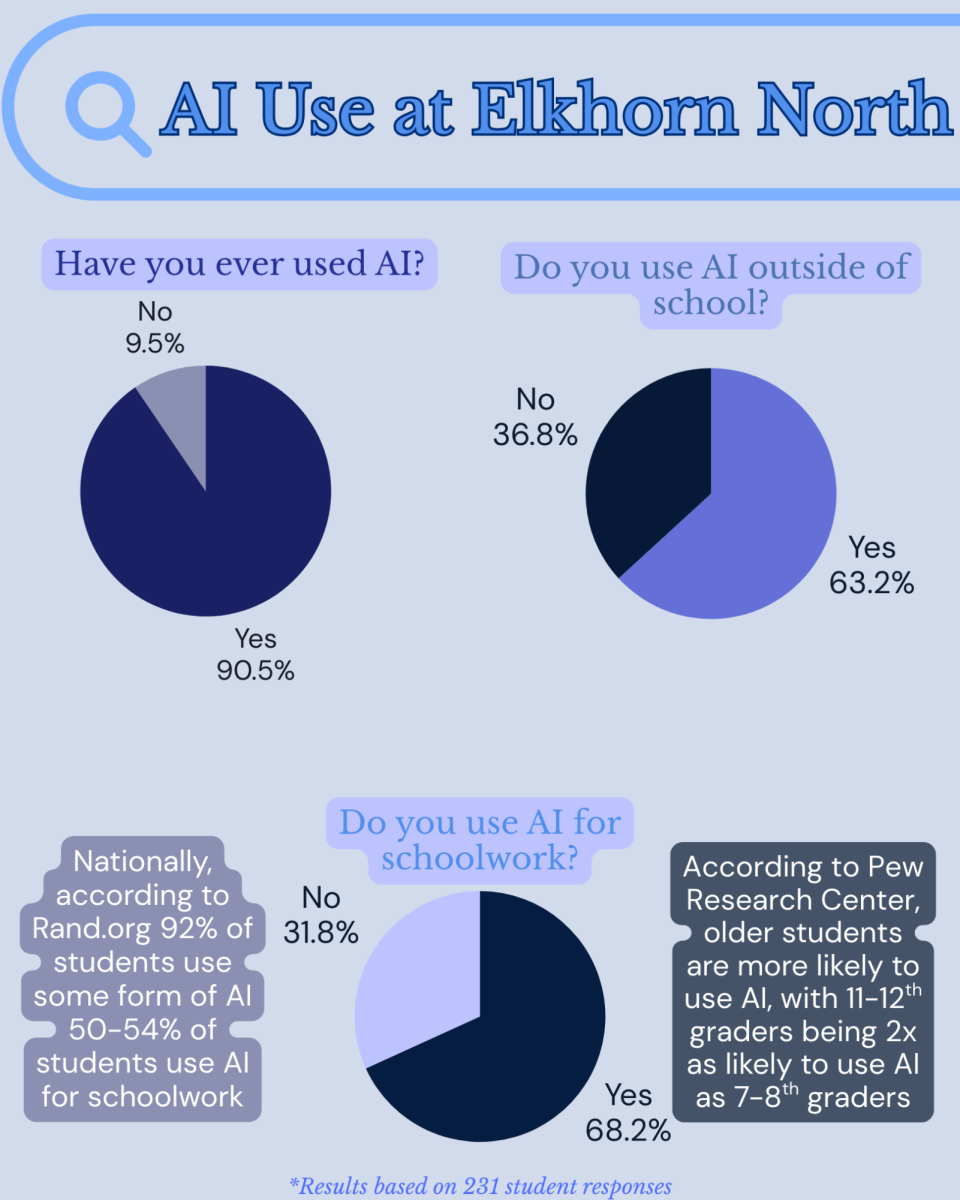
68.2% of students surveyed responded yes to the question: “Do you use AI for school work?” The top five subjects that the students who participated in the survey stated they use AI for were science (61%), math (56.2%), history (54.8%), English (50%), and foreign languages (22.6%).
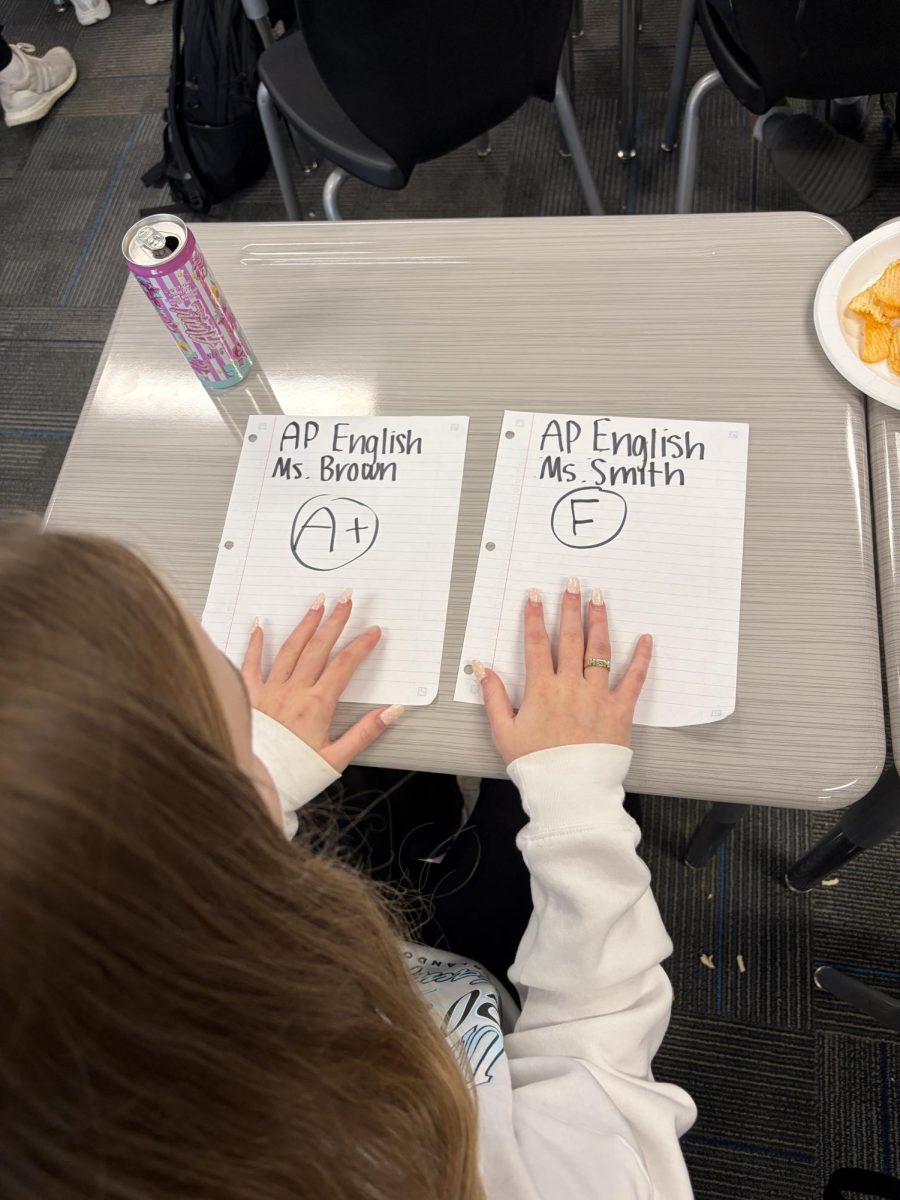
In a survey of over 200 Elkhorn North students, only 11.9% have been flagged for AI when they did use it. In the same survey, 35.3% claimed they have been flagged when they did not use it.
The outcomes of both of these situations vary. Numerous innocent writers have had to accept a zero for work that was all their own. Others have been successful in emerging unscathed, with no suspicion from their teachers.
“I got a zero and didn’t get the opportunity to redo it even though I didn’t use AI in that case,” one anonymous survey responder said.
In both the teacher and student surveys, participants were asked how reliable they think AI detectors are, with five being highly accurate and one being highly inaccurate. Across both surveys, the majority of answers were in the middle. 45% of students and 41.5% of teachers voted three.
Most teachers claimed that they did not have a preferred AI detector, but did argue that there are clear signs of students using AI. Excessive punctuation, processes and information not covered in class, and language that doesn’t sound like the student in question are all signs that teachers say point to AI usage.
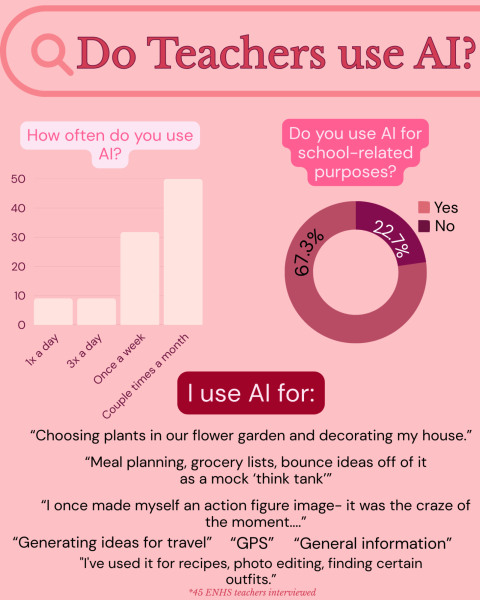
54.8% of teachers surveyed also responded yes to the question over use of AI. Some use the technology to create lesson plans or assignments. Others use it to refresh their memories on certain topics for class or to write emails.
The thing is, students and teachers show similar patterns in their use of AI. 32.8% of students and 37.1% of teachers claimed they use AI a couple of times a month.
50-60% of students and teachers use AI for purposes outside of school. They both use the tech to ask questions, generate images, recipes, and create workout plans.
In both groups, over 50% of respondents shared that they use AI for school purposes. Generating ideas, helping with writing, answering questions, checking work, and summarizing topics are all things that students and teachers alike use AI for regarding academics.
Of course, students should focus on doing their own work for their own personal benefit, but teachers cannot expect them to fully terminate their use of AI if they don’t do so themselves.
“There are a lot of expectations on students and they require them to do a lot of homework,” one anonymous teacher said. “There is a negative impact when students aren’t processing what they are learning, however, I think we put them in a corner that makes them feel forced to use it.”
The teachers surveyed were split on their opinions over the technology. Some claim that it is useful when used right, and harmful when used incorrectly. Others are completely one side or the other.
Contrary to popular belief, students largely answered the same, with most individuals fully aware of the negative side of AI usage.
It is easy to focus on the friction AI causes between educators and scholars. Concerns of integrity and the fear of replacing intuition and creativity are commonly held by today’s teachers.
Looking closer, there is a shared evolution. Both groups are learning to navigate the AI landscape and the challenges and uncertainty it brings. Each side has their own ideas of what the policy should be regarding the technology.
Some students consider AI negative for society as a whole: “AI in my opinion is bad for the learning experience for students due to the fact of the false hope it can bring because most people think AI has all the correct answers,” and “It shouldn’t even be used as a tool, that just conditions people to default to it when they’re stuck.”
Others have the opposite opinion: “AI should be allowed for figuring out steps to a difficult problem or exploring ideas for an essay,” and “I think it should be implemented more because our economies are using new and smarter technology so we should capitalize on that and use AI to help students.”
Teachers responded that AI use should be prohibited in schools, but students should be allowed to freely use it outside of school.
The ‘us versus them’ mentality is ineffective to the larger problem that today’s students will have to grow up and face without an authority figure’s help.
It is imperative that AI isn’t treated as a threat to some and a secret tool for others, but as a new technology that both groups need to do their part to regulate and use responsibly.