

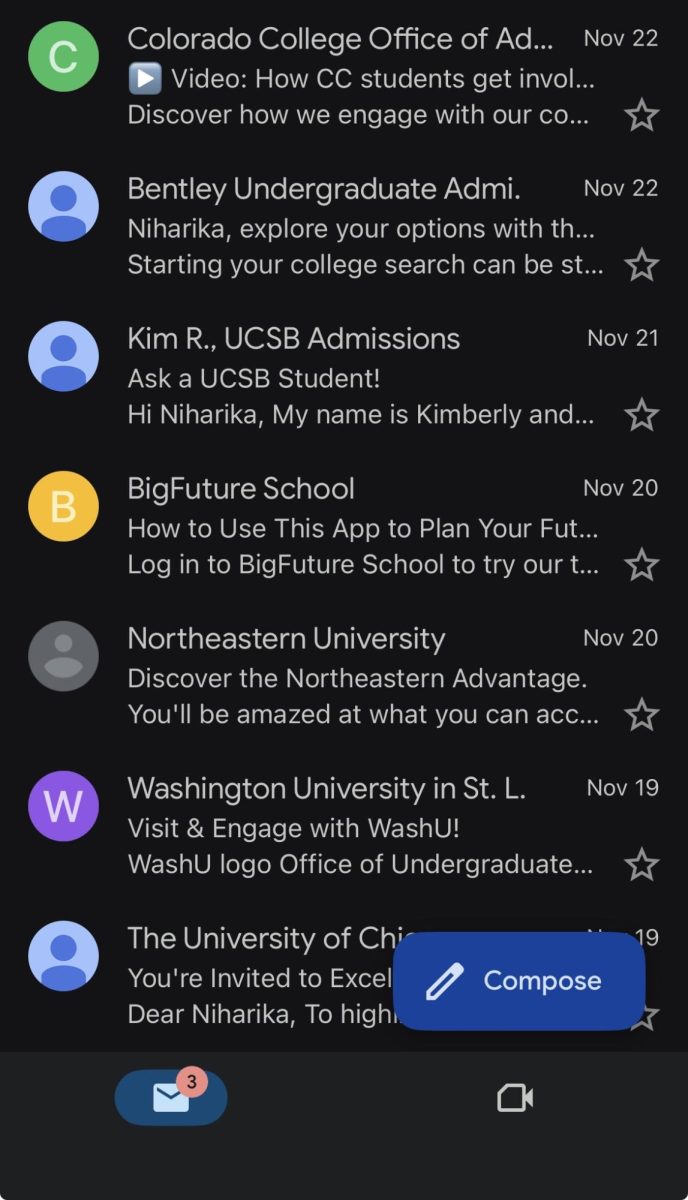
I was a rising sophomore the first time an Ivy League school emailed me. I thought I had just secured admission into an Ivy, until I Googled what an email from a college actually meant.
Every year, millions of emails are sent out to high schoolers from nearly every type of college. While the common belief is that if a high schooler receives an email, the college is interested in them, that is not the case.
According to Brookings.edu, colleges are just like any other business; they spend substantial amounts of money on advertisements to attract as many applicants as possible. The best way to advertise their school to as many students as possible is to send out emails, so many colleges buy names off CollegeBoard and other reliable websites, and get to work sending as many emails as they can. Then, when everyone thinks that Yale or Harvard wants them, they apply, only to get brutally rejected.
“I just don’t see why they show interest in you and then reject you,” junior Abhirup Koduru said. “I guess whatever happens, happens, but I don’t see why they have to act like they want you.”
It’s cruel, but it serves a purpose. The more applicants a college gets, the more people they can reject, making their acceptance rate lower and therefore more “prestigious.”
“I get that it’s a marketing strategy, but it gives people a false sense of hope,” junior Krishna Penmetsa said. “I don’t like how they play with people’s feelings.”
Penmetsa, hopes to go to MIT, but considers it to be just a dream school.
“I know [rejection] is bound to happen,” Penmetsa said. “I’m not waiting for the rejection letter. I’ve already started coping, so I don’t care when it actually happens.”
Penmetsa isn’t being negative; he’s just being realistic. The American Economic Association says that college admissions have never been more competitive, while the National Library of Medicine says that more and more students are retaking the SAT and ACT to achieve scores in the 90th or higher percentiles.
In my experience, the people I’m going to have to compete with when it comes time to apply to college are simply on another level. Earlier, I was scrolling on Instagram when I saw a video where a counselor was reading a list of one of his student’s extracurriculars. He was planning to graduate at 17, had not one, but two, nonprofits that had raised over $50,000, was a National Merit Finalist, had published research, interned at his local bank, had been on the varsity basketball and track team every year of high school, and had placed at International DECA. He also had a perfect unweighted 4.0 GPA, 34 ACT, and 1550 SAT. While everything online cannot be immediately believed, I have spoken to many students who have college resumes similar to this one.
“Applying to college sounds so hard,” junior Xavier Johnson said. “There’s so many people that are going to have better grades or extracurriculars than me.”
It’s impossible to think about college and not wonder “what if?” What if it’s too expensive? What if I get no scholarships? What if I get waitlisted from my dream school? What if my application doesn’t submit in time? What if I don’t get accepted to my top schools? What if I get rejected from every single school that I apply to? What if I’m not good enough?
“You just have to thug it out,” sophomore Ellie Duan said. “If you set your expectations to rejection, then you’ll never be disappointed.”
Duan wants to go to Cornell, an Ivy League school in Ithaca, NY, known for its beautiful campus and incredibly selective admissions. Duan, who is in accelerated math and science programs, has taken AP classes outside of Elkhorn North, and is involved in many extracurriculars, doesn’t believe in stress.
“I don’t have any advice [for academic stress],” Duan said. “If you don’t get into your top school, what’s the worst that’s gonna happen?”
Junior Abhirup Koduru wants to go to The Ross Business School at the University of Michigan, one of the best business schools in the country. He deals with the stress of college rejection in a slightly different way.
“I get in bed and I cry it out, and then I play Fortnite when I get home, maybe a little bit of Clash on my phone,” Koduru said. “I’ll talk to my friends and we’ll cry about it, and then I cry more, and then I’m okay.”
Brayden Bae, a former student at ENHS, was rejected from his top school (Cornell), as well as every Ivy, except the one he attends now. Bae goes to Brown University, an Ivy League with an acceptance rate of less than six percent. He applied to over fifteen colleges, and faced a significant amount of rejection.
“Looking back, Brown definitely fits who I am and my personality more than other schools. Hearing from people across other colleges, I’m not sure I would have liked my dream colleges,” Bae said. “A lot of the time, colleges you hadn’t really thought about end up being the best match for you.”
But just because there is a possibility of getting rejected doesn’t mean that everyone should just give up.
“I’m just going to work my hardest, and if it happens then great,” Koduru said. “College isn’t the final thing in life.”
Warren Buffet, an Omaha local who has one of the highest net worth’s on the planet, went to both the University of Nebraska at Lincoln and the University of Pennsylvania.
“In America, if you go to any college and you work hard and you’re a good person, you can make a good life for yourself,” Duan said.