

The 2024 school year unveiled new lows for the class of 2025, with average reading and math scores reaching their lowest marks in over 30 years.
This information derives from the National Assessment of Educational Progress (NAEP), a branch of the US Department of Education. This program works to provide up-to-date tests for randomly chosen students within varying public, private, and charter schools across the nation. This test works differently from more commonly known tests such as the ACT or SAT, which are taken for standardization across college admissions.
The NAEP’s test is directly focused on testing the state of the nation’s K-12 students and is meant to compare how students from all sorts of backgrounds compare to their peers across the country. The results from NAEP are meant to influence and teach educators, politicians, and parents about how their students are performing and what changes to the education system are necessary in order for the future generations of America to be most successful.
“Without an assessment like NAEP, inequities become effectively invisible in our education system and, therefore, impossible to address,” Executive Director at the Research Alliance for NYC Schools, Cheri Fancsali, said in an email to Industry Dive. “The NAEP is the only standard assessment across states and districts, so it gives the ability to compare over time in a way that you can’t with any other assessment at the local level.”
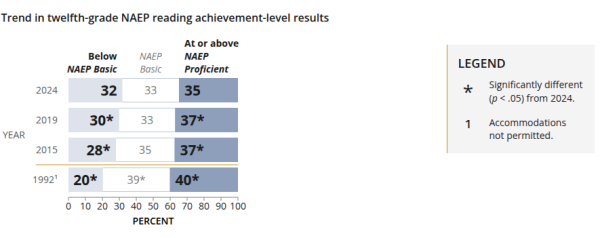
This test, conducted throughout January and March of 2024, assessed nearly 20,000 students in the class of 2025 in math and roughly 24,000 in reading. The test evaluated seniors from 1,600 U.S. schools. The results showed that only 35% of 12th-grade students were at or above the NAEP Proficient level in reading, and 22% were proficient in math. Also, 32% are below the NAEP basic level for reading and 45% for math. This reveals a steep drop in scores across the board, with results reaching their lowest since the tests’ introduction in 1992.
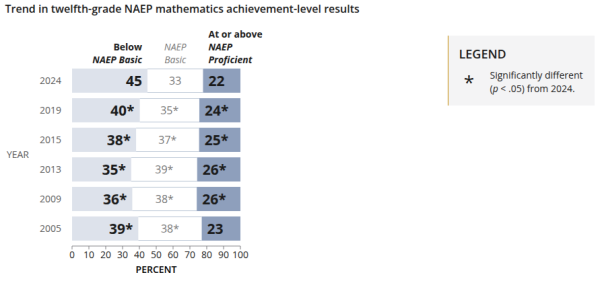
Graph showing NAEP math results for 12th grade (Image from NAEP report cardEducation Secretary Linda McMahon had choice words in response to the continuously decreasing scores.
“American students are testing at historic lows across all of K-12.” McMahon said in a statement on Congressman Tim Walberg’s website. “Nearly half of America’s high school seniors are testing at below basic levels in math and reading. The achievement gap is widening, and more high school seniors are performing below the basic benchmark in math and reading.”
The NAEP has attributed the drastic decrease in scores from the past years to multiple reasons: chronic absenteeism, lack of challenging courses, decreased academic confidence, and the generation’s increased screen time, leaving students inadequately prepared for college.
The test distributed to these students asked takers to list the number of days they missed school in the past month. Results showed that 31% of 12th-grade students missed three or more days of school, a 5% increase from 2019.
Unsurprisingly, students scoring under the 25th percentile missed more school than students scoring above the 75th percentile.
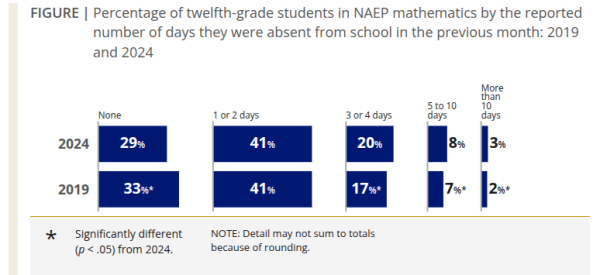
This chronic absenteeism has many possible reasons as to why it is such a problem in the current education system. The US Department of Education describes chronic absenteeism as missing 10% of school or more. They have pinned this problem to factors such as student disengagement, lack of student support, and personal/family health issues.
Another prominent issue noted by the NAEP was a lack of challenging courses. The math assessment asked students for the highest-level math course they had taken. 43% of students said Calculus/Precalculus, 45% said Trigonometry or algebra two, and 12% said Geometry or Algebra one as their highest level math course. These students who were enrolled in Pre-Calculus or Calculus classes scored at or above the 75th percentile in the math assessment at a significantly higher rate compared to students enrolled in lower math courses.
Cell phone use has been directly linked to the decrease in students’ grades and classroom performance. Students whose phones were removed from their persons during class experienced a better learning environment. Students were able to comprehend the material better, reduce distractions, and reduce anxiety. Nearly 80% of U.S. public schools have implemented cell phone policies to try to negate the academic distractions phones bring.
“I’m convinced that this technology is a key driver of youth mental health challenges, a distraction from learning, both inside and outside of schools, and a deterrent to reading,” VP of the National Assessment Governing Board Martin West said.
The NAEP noticed a large disparity of students enrolled in college to the number of students academically prepared for college. For the two NAEP assessments, 53% of the students in the reading portion reported being accepted into a four-year college (a 2% decrease from 2019), and 54% for the math test (a 3% decrease from 2019). Overall, NAEP data calculated that an estimated 35% of students were academically prepared for college reading, with 33% prepared for college math. These results are significantly lower than in the 2019 assessment, with reading dropping 2% and math 4%.
Statistically, not every senior entering college is prepared for college-level courses, a concerning problem for the education system.
“Low academic skills don’t just hurt grades; they weaken our economy, workforce, and national security,” House Education Committee Chairman Tim Walberg said. “Without strong foundations in these core subjects, America’s freedom and economic competitiveness will be in jeopardy.”
The nation’s test scores raise an alarming concern for the state of American high schools and the ability of the education system. One school district that has consistently risen above standards despite nationally diminished results is Elkhorn Public Schools.
In the 2023-24 annual report, EPS said its goal was to remain dedicated to providing high-quality education for all students. With a continually increasing student population, EPS is committed to fostering an environment that empowers each student to reach his or her full potential.
Elkhorn has proven to be dedicated to quality and dedicated education. There is a standard of excellence and dedication for both students and teachers.
“There has been this culture of students buying into academic success,” English teacher Amber Sims said. “We have a high standard of education with systems in place that help students be successful.”
The 2023-2024 EPS school year proved to be one of Elkhorn’s many successful years. Tests such as the NSCAS and MAP tests given to elementary/middle schoolers showed significantly higher scores compared to schools across Nebraska and the nation. The ACT showed a consistent level of advancement across grade levels compared to national averages.
“The demographics in Elkhorn naturally lend themselves to students’ success with the resources and support a lot of our students have,” Sims said. “Everything is very intentionally made from a district-wide perspective. Every single student is getting the same education.”
Although it is difficult to compare ACT results to NAEP results, Elkhorn has kept a high standard in education that has led to advanced ACT scores, despite the drop in national NAEP scores. The 2024 EPS ACT showed an average composite score of 23.4 for the class of 2025 compared to the Nebraska average of 18.7. EPS’s class of 2024 graduated with an average composite score of 23.3, with the national average at 19.4.
“Elkhorn has definitely prioritized test-taking skills,” senior Harrison Allen said. “My education in the Bellevue school system and overseas in England, when I used to live there, showed me how teachers really don’t prepare students for tests, but only supply us with information.”
EPS excellence stems beyond the high test scores across the board. Students have consistently challenged themselves and improved. The 2023-24 school year had 55% of students from grades 10-12 take at least one AP course. Of the over 1,200 students who took an AP test in 2024, 85% earned at least a 3 or higher on the test, earning a college credit.
Nationally standardized tests show some of the lowest scores seen in nearly 30 years. This leaves a concerning problem for the future of America. Elkhorn Public Schools has remained academically excellent despite the nationally dropping averages . These issues need to be addressed, and changes need to be made in the nation’s education system in order for the future leaders of America to be most successful.